
Why does logging in to an exchange feel like a legal, technical and psychological test all at once? For US-based traders using OKX, the login and verification process is the gatekeeper that mediates access to spot trades, high‑leverage derivatives, staking vehicles and a Web3 wallet. Understanding the mechanisms beneath the buttons — what the exchange checks, why it asks for particular data, and where the trade-offs sit between convenience and regulatory safety — makes the routine act of “signing in” a deliberate risk-management step rather than a nuisance.
This explainer unpacks the OKX account and verification flow, the security primitives the platform uses, how verification affects product access and limits, and the practical decision rules a trader should use before entering credentials. I’ll also highlight a recent platform housekeeping step — the delisting of several low-volume tokens — as a concrete reminder that account access is only one part of exchange risk management.
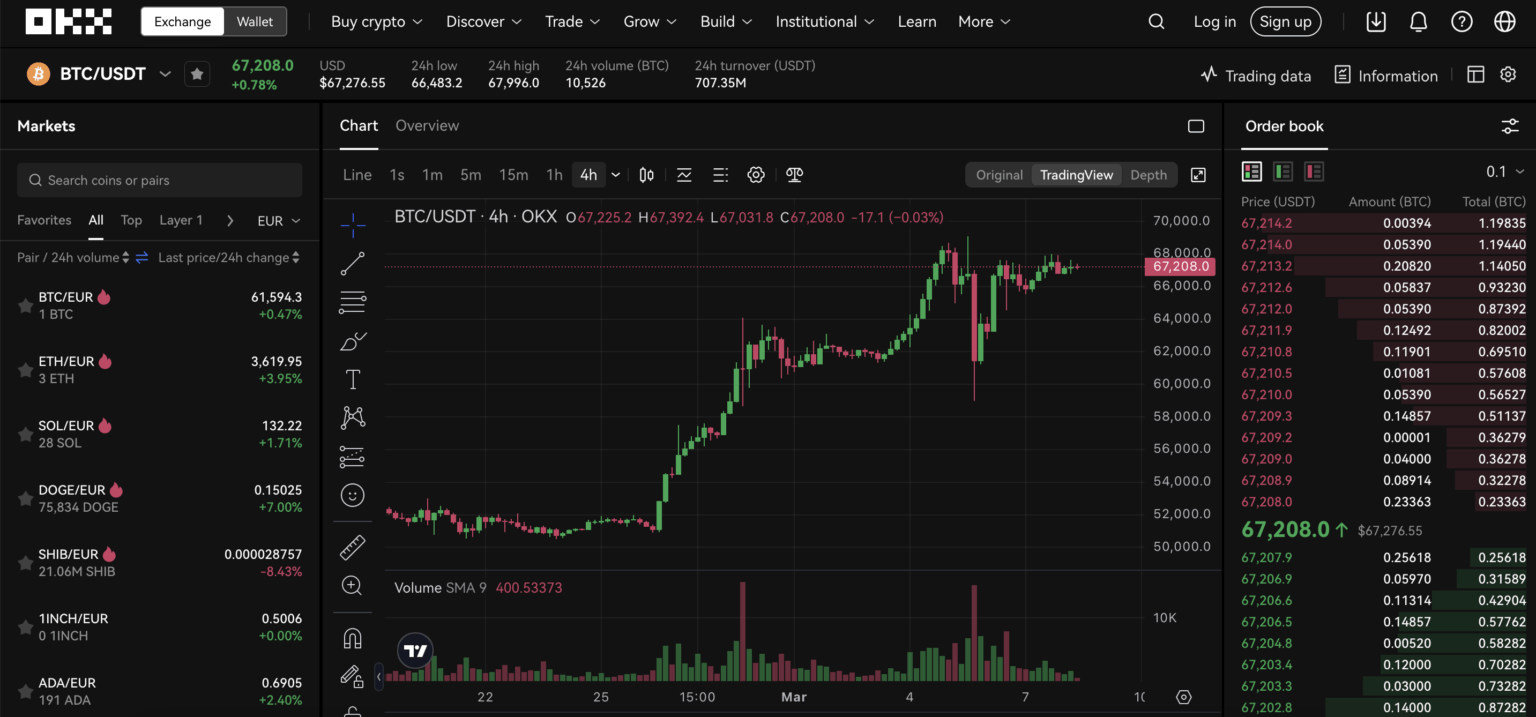
How OKX verification works: mechanism, data flow, and why it matters
At its core, OKX follows the familiar CEX (centralized exchange) verification sequence: create an account, confirm contact details, complete Know Your Customer (KYC) identity checks, and enable account protections such as Two‑Factor Authentication (2FA). Mechanically, KYC means submitting a government‑issued ID and a liveness or facial recognition check. That biometric step pairs an image of your face, captured live, with the photo on your ID—an automated match that reduces simple ID fraud but raises familiar accuracy and privacy questions.
From a systems perspective, verification serves three functions. First, it provides AML compliance signals to regulators by linking on‑chain and off‑chain activity to a real person. Second, it assigns risk and product entitlements within OKX’s internal policy engine — for example, margin and derivatives access, withdrawal thresholds, and fiat on‑ramp options. Third, it acts as a behavioral unblock: completed KYC reduces the number of time‑limited holds on transfers and simplifies customer support interactions. The trade-off is explicit: greater convenience and entitlement in exchange for surrendering more identity data to a centralized custodian.
Login security: what is strong, what still breaks, and practical rules
OKX layers several security primitives. Military‑grade encryption protects stored credentials; AI‑driven monitoring looks for anomalous login patterns; mandatory 2FA options (SMS, Google Authenticator, biometrics on mobile) add second-factor protection; and the platform claims >95% of funds are stored in air‑gapped cold wallets with multi‑signature withdrawal controls. Those are technically solid defenses against large‑scale theft, but they do not eliminate all risk vectors.
Where these defenses can fail: phishing campaigns that trick users into entering credentials on lookalike sites; SIM swap attacks that bypass SMS 2FA; and social engineering of customer support to lift holds or reset keys. For Web3 interactions using OKX’s non‑custodial wallet, user errors like losing a seed phrase or approving a malicious contract call remain orthogonal risks that encryption and cold storage cannot fix. So the practical rule for traders is layered: (1) use an authenticator app or hardware 2FA rather than SMS; (2) enable device biometrics only on trusted personal devices; (3) treat email and SMS as notification channels, not the final line of defense.
Verification levels and product access: mapping what you can do after each step
KYC level determines what parts of OKX’s ecosystem you can use. Basic accounts may access spot trading and limited withdrawals; completed identity verification unlocks larger fiat rails, higher withdrawal limits, margin trading up to specified leverage, and derivatives such as perpetual swaps and options. Advanced derivatives trading can permit very high leverage (up to 125x on some instruments), which magnifies both potential return and catastrophic loss. A clear decision heuristic: don’t seek maximum entitlements until you understand margin mechanics and tail‑risk — leverage is a tool, not a shortcut to returns.
Another operational implication: verification status affects dispute resolution. If your account is fully verified, support is more likely to grant procedural remedies because the exchange has stronger identity linkage; conversely, unverified or partially verified accounts face stricter holds. For US residents, where regulators scrutinize fiat flows and AML controls, accurate KYC is not optional if you plan to use USD rails or bank/ACH connections.
Delistings, liquidity and why verification is only part of the story
Recent platform housekeeping—OKX’s delisting of several spot pairs—illustrates a separate dimension of exchange risk. Delistings typically target low‑liquidity, high‑volatility tokens that create market‑integrity issues: wide spreads, price manipulation potential, and mismatched custody obligations. Even with a fully verified account, you can be affected: orders may be canceled, holdings converted to a different asset or subject to withdrawal windows. The practical insight is to treat exchange custody as a set of conditional promises: OKX provides strong custody safeguards (cold store, PoR transparency), but operational decisions like delistings, maintenance windows, or temporary liquidity stress are policy choices that affect access independent of your login state.
Decision framework: when to trade on OKX and when to use alternatives
Use this short heuristic to choose between trading on a centralized venue like OKX, using the non‑custodial wallet, or routing to DEX liquidity:
– If you need low latency, margin/derivatives, or fiat rails, a verified OKX account is appropriate. The trade-off is regulatory exposure and centralized custody.
– If you prioritize custody and absolute control of private keys, use the OKX non‑custodial wallet or hardware wallet integrations and accept slower fiat movement or fewer derivatives.
– If you need cross‑chain swaps without giving up custody, consider DEX aggregators (OKX includes one) for spot swaps, but accept slippage and smart‑contract risk. Always match the tool to the economic primitive you need: execution speed, leverage, custody, or anonymity.
FAQ
Do I have to complete KYC to trade on OKX from the US?
Yes — to access most fiat rails, larger withdrawal limits, and many trading products you will need to complete KYC, which includes an ID and a liveness (facial recognition) check. Some basic trading may be possible with limited verification, but regulatory constraints in the US mean full functionality requires identity verification.
Is the OKX login safe on mobile and should I use biometrics?
Mobile login with biometrics is convenient and generally secure on a trusted, updated device. Biometrics protect the local device unlock, but they don’t replace 2FA for account changes. Use an authenticator app or hardware 2FA for the best compromise between usability and security.
What happens to tokens that get delisted?
Delisted tokens may be removed from trading pairs, and exchanges often provide a withdrawal window for holders. In some cases the exchange may convert low‑liquidity assets or disable deposits. Delistings are a reminder that custody on an exchange includes policy risk as well as theft risk.
Can OKX’s Proof of Reserves fully eliminate solvency risk?
Proof of Reserves increases transparency by showing on‑chain backing at moments in time, but it does not replace ongoing operational audits, nor does it prevent fraud, accounting errors, or short‑term liquidity freezes. Consider PoR a useful signal, not a guarantee.
Practical next steps for a trader who wants to proceed: complete KYC carefully using a secure connection, switch to an authenticator‑based 2FA, and test small withdrawals to verify withdrawal whitelists and bank link behavior before allocating significant capital. If you are primarily concerned with custody, open the OKX non‑custodial wallet and consider hardware wallet integration. For direct login help and the official web route to start, this OKX login page may be useful: okx login.
What to watch next: regulatory guidance in the US about stablecoins and derivatives, exchange policy shifts on token listings (the recent delistings are a signal, not an isolated event), and evolving authentication threats such as increasingly sophisticated phishing kits and AI‑driven social engineering. Each of those alters the effective risk of logging in — and should influence whether you trade on margin, hold assets on‑exchange, or migrate to self‑custody.